Curator Spotlight
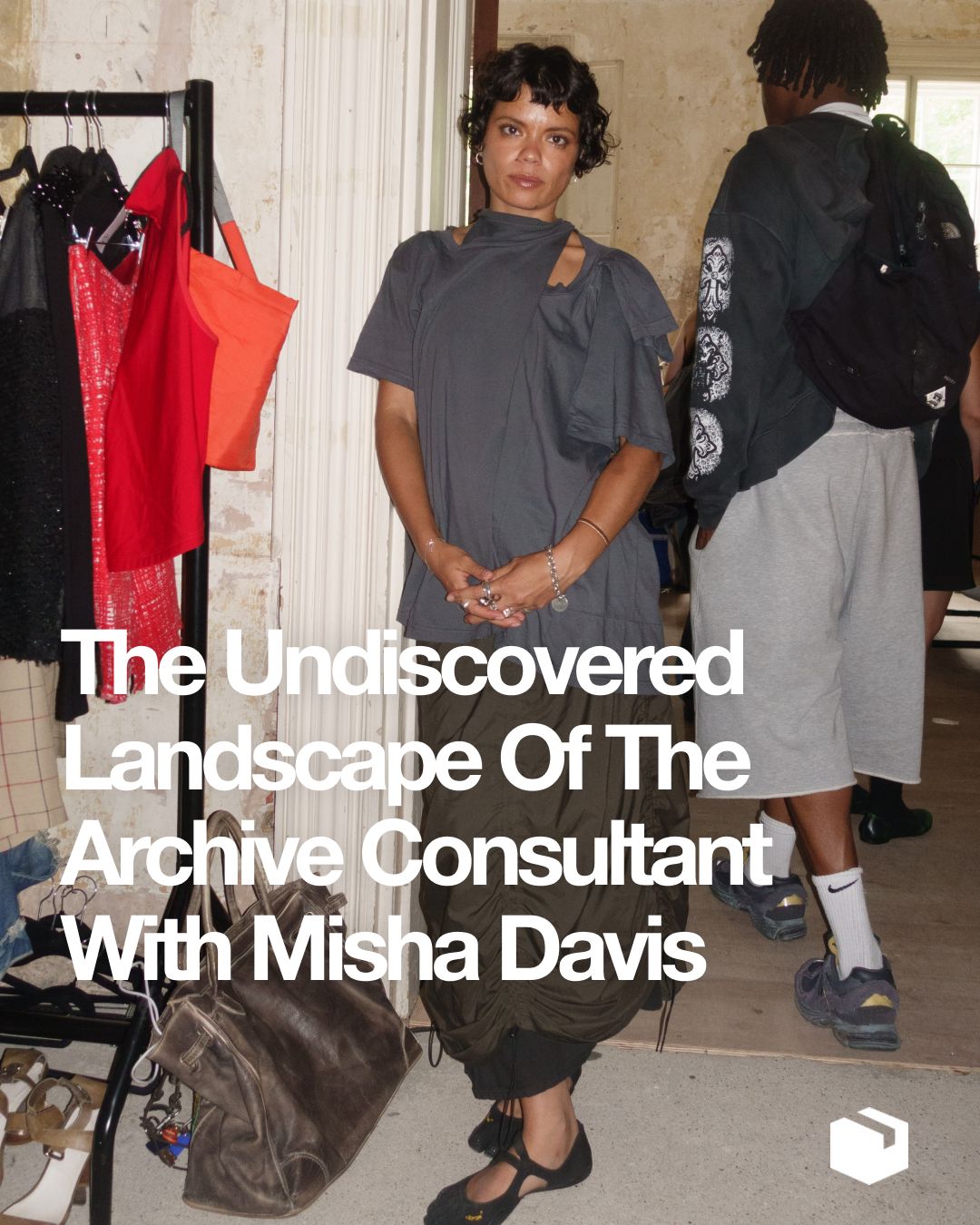
Misha Davis — The Undiscovered Landscape of the Archive Consultant
Everything now is sequels, prequels, remakes, reboots, live actions, or reimagined versions of things that already existed because industries are scared to take risks on completely new ideas. Fashion is doing the exact same thing.
By Stella
Featured in this post
Shop Misha's picks:
https://www.storageplatform.org/boards/shared/misha-s-picks-3afb0ac7
How do you define your role within the industry?
To me, it’s less about simply sourcing vintage and more about translating context and emotion. A lot of people can find old clothes, but understanding why a piece mattered culturally, emotionally, or visually at a certain time and why it still resonates now is the real work.
The role sits somewhere between researcher, stylist, curator, and storyteller. A big part of what I do is bringing pieces back into contemporary spaces in a way that still carries the feeling they originally had. Whether it’s an editorial, performance, campaign, or music video, archival fashion can instantly connect people to a specific era, memory, or cultural moment.
I think people are craving that sense of nostalgia and tangibility again. We live in a time of constant content and very fast consumption, so archival pieces almost slow people down emotionally. Someone recognises a bag, a silhouette, a jacket, or even the way something was styled, and it triggers a memory or feeling connected to that time.
That’s the part of archive culture I’m most interested in, the storytelling. Not just the rarity of a piece, but the history and emotion attached to it, and how that can still communicate something powerful today.
Why is YSL re-releasing the Mombasa?
Pieces tend to come back when the wider culture catches up to them again, but a lot of the time that process actually starts within archive communities first.
Archivists and collectors begin noticing patterns. Certain bags, silhouettes, shoes, or collections start reappearing in conversations, sourcing circles, editorials, or on archive pages. Then more collectors start picking up on those same pieces, which creates momentum around them. From there, it trickles down through social media and short form content very quickly.
Suddenly, people who may have never known the original context of a piece are repeatedly seeing it online, associating it with aspiration, taste, or status, and it becomes a trending product again. Fashion houses obviously pay attention to that. They realise that a product they released twenty years ago is gaining traction in the second hand market, and instead of allowing that circulation to exist independently, they want to monetise it again themselves.
The Mombasa is a perfect example of that. Originally, it represented a very specific moment in fashion, the Tom Ford era sensuality and glamour that felt bold, decadent, and slightly dangerous compared to the cleaner minimalism we saw dominate for years afterwards. Now fashion is moving back toward personality, texture, and emotionally charged accessories again, so naturally pieces like that resurface.
But I think there’s also tension there for people deeply involved in archive culture. A lot of these pieces become mythologised online first, and then reissued for a mass consumer who discovered them through trend cycles rather than genuine emotional connection to the original era.
Even the marketing reflects that shift. Using someone like Bella Hadid as the face of the reissued Mombasa makes complete sense commercially because she represents that highly visible, trend driven consumer culture that dominates online fashion spaces right now. Brands know exactly who they’re targeting when they do that.
But for archive collectors, it can feel conflicted because the original pieces carried a different energy and context. The reissues often lack the same fabrication, construction, or emotional weight that made the originals special in the first place.
You see this happen constantly. Levi’s, for example, became very aware that vintage Levi’s were circulating through resale, being upcycled, reworked, and even incorporated into collections by designers like Margiela. Brands don’t necessarily want the second hand market profiting from their cultural legacy without them participating in it.
So there’s this cycle where archival pieces gain traction organically through collectors and resale culture, brands reissue them for profit, mass consumers buy into the trend, and then people eventually circle back to the originals anyway because they still want the authenticity, quality, and emotional connection the newer versions often can’t replicate.
I think consumers can feel that difference instinctively, even if they can’t always articulate it directly.
How would you like to see brands communicate with their history?
I’d like to see more honesty and depth.
A lot of brands reference heritage visually, but don’t communicate the process or context behind those references. There’s so much interesting history in fashion beyond the obvious “iconic” moments.
I think brands should engage with archives as research rather than marketing. There’s value in showing experimentation, failed ideas, transitional collections, wear, ageing, all the things that make clothing feel human over time.
What shits you off about current fashion?
What frustrates me about fashion right now is how difficult it’s becoming to maintain individuality when everything is so visible all the time.
One of the reasons I was originally drawn to vintage and archival fashion was because so much of it felt one of one. You could find a piece that genuinely felt personal to you, and there was a very small chance someone else would come across it again, let alone style it the same way. That rarity allowed people to build identities through clothing in a much more instinctive and individual way. Now, because of constant online access and short form content, something can go from obscure archival piece to global trend almost overnight.
I also think fashion has lost a lot of its geographical identity. In the ‘60s, ‘70s, ‘80s, ‘90s, and even early 2000s, subcultures and styles were much more tied to specific places and communities.
In Japan, you had Harajuku, Lolita, kawaii culture, cosplay, all very rooted in a specific environment and social context. In the UK, movements like punk, skinhead, suedehead, and mod culture had a distinctly British identity tied to music, politics, and class. Vivienne Westwood helped shape an entire visual language around punk that felt uniquely British at the time. In the US, hip hop and streetwear culture in the ‘80s had a completely different visual identity connected to geography, music scenes, and lived experience.
Now, because everyone has immediate access to everything all at once, those boundaries have collapsed. Inspiration spreads instantly, but so does homogenisation. Trends no longer stay cultural or regional long enough to fully develop depth before they’re consumed globally and reproduced repeatedly.
I think that’s also why I’ve become more selective with what I collect and circulate through Average Local. Once something becomes overexposed online, it can lose the tension and individuality that made it exciting originally.
Archive culture used to feel like discovery. Now sometimes it feels like watching the same five pieces rotate between celebrities, stylists, archive pages, and TikTok moodboards until everyone collectively decides they’re over it two months later.
Sometimes fashion today can feel less like self expression and more like algorithmic repetition.
How valuable are your relationships in the role as an archive consultant?
They’re essential.
A lot of the best pieces never publicly surface. Relationships build trust, and trust gives you access, whether that’s collectors, resellers, stylists, photographers, or former industry people. The archive world is actually much smaller than people think, so your reputation travels very quickly.
Trust is also a huge part of my role as an archive handler. I’ve handled garments worth well over £50,000 that are genuinely one of one pieces, and collectors are trusting me to transport, style, store, and protect them properly on shoots, performances, and jobs.
Being both a collector and reseller through Average Local also changes your relationship to clothing emotionally. Some of these pieces live with you for years before they ever leave your hands, so when you loan them out, there’s a weird balance between professionalism and emotional attachment.
Sometimes pieces come back damaged, stretched, marked, or altered, and you kind of have to stand there pretending you’re emotionally stable about it when internally you’re mourning like a Victorian widow.
Trust becomes everything because these aren’t just products. A lot of the pieces circulating through Average Local hold personal, historical, and emotional weight for me.
Walk me through one project from brief to deliverable?
In the nature of my work with a lot of celebrity clients and working with other stylists for their celebrity clients, there are usually a lot of NDAs involved, so I can’t specifically talk about one project in particular. But in the grand scheme of things, it usually starts with research and defining the visual language properly.
I’ll pull references across collections, campaigns, runway details, fabrication, casting, styling, music, and cultural context, not just garments in isolation. Especially with celebrity clients, the process becomes very personal because you’re building around an individual, their public image, their audience, and the kind of narrative they want to communicate visually.
From there, I start sourcing pieces, building edits, and refining what actually feels authentic to the project rather than just aesthetically correct. Then it becomes more collaborative. Fittings, styling conversations, creative direction, tailoring, security logistics, archive approvals, insurance, pull requests, transport schedules. There’s a whole operational side people rarely see.
Archive handling itself can also be incredibly stressful. Some garments are museum level pieces or genuinely one of one, so there’s a huge amount of responsibility attached to moving and caring for them properly.
DHL and FedEx are basically out of the question with certain archive garments. It’s hand carry or nothing. You’ll literally travel internationally with a single garment like it’s a newborn child.
People definitely romanticise archive work because the end result looks glamorous, but a lot of the reality is logistics, problem solving, and low level anxiety about a dress existing in the backseat of an Uber.
Suggested Q+A
What would you grab from a fire?
I think most people would assume I’d instantly grab one of my Vivienne Westwood pieces, and honestly, they probably wouldn’t be wrong. I own an original Seditionaries T shirt from the Sex era, Malcolm McLaren, Vivienne Westwood, all of that history attached to it, and culturally that piece feels almost impossible to separate from the political energy and rebellion of that time.
But then the other side of my brain starts thinking about construction and design innovation, and in that case I’d probably save my Junya Watanabe skirt from Fall/Winter 1997.
Then realistically, if I had another thirty seconds, I’d probably start panic grabbing my McQueen pieces from the Spring/Summer 2005 menswear collection with all the mirrored embellishment and embroidery, plus a couple pairs of McQueen bumsters while I’m running out the door like a looter during an apocalypse.
But emotionally, I think the Seditionaries shirt still wins.
I still need to create a board with my top nine items in storage.
What kinds of pieces are you always drawn to?
I’m always drawn to pieces with strong identity and emotional weight, especially anything connected to punk culture and Vivienne Westwood’s ‘70s punk era.
Through Average Local, I’ve naturally gravitated more toward Japanese and conceptual designers from the ‘90s and early 2000s, pieces that feel slightly under the radar or intellectually strange rather than immediately recognisable luxury products.
I used to collect a lot more Prada and Miu Miu, but honestly the archive market became so saturated with those pieces that I started losing emotional interest in them. The more something becomes reduced to trend circulation and celebrity placement, the more it can lose the intimacy and subcultural energy that made it interesting in the first place.
Eventually certain pieces become so overexposed that they stop feeling archival and start feeling like they’ve been algorithmically flattened into trend products.
That’s usually when I mentally check out and start looking elsewhere again.
Why do you think archive fashion has become so popular again?
I think archival fashion mirrors what’s happening in film and wider culture generally. Everything now is sequels, prequels, remakes, reboots, live actions, or reimagined versions of things that already existed because industries are scared to take risks on completely new ideas.
Fashion is doing the exact same thing.
People are turning back toward pieces that already proved they had cultural relevance, emotional impact, or recognisable identity because brands know there’s already an audience for it. We’re living in a time where content consumption is so fast and disposable that people cling onto familiarity because it feels emotionally safe.
That’s why you’re seeing fashion houses constantly reproducing collections or products that resonated heavily in the ‘90s and early 2000s.
Jean Paul Gaultier has continuously reissued its iconic mesh prints from the ‘90s and early 2000s. Prada has revisited Prada Sport repeatedly, especially references from Spring/Summer and Fall/Winter 1999. Miu Miu bubble sole sneakers, mules, and shoes resurfaced again recently after becoming cult archive collector pieces for years. Even the YSL Mombasa returning is part of that same cycle.
For the mass market consumer, that’s exciting because they’re getting access to pieces they maybe missed the first time around.
But for archive collectors and people who genuinely care about fashion history, it creates a weird tension because those original eras were so specific culturally and creatively. Fashion in the ‘90s and early 2000s felt genuinely risky.
John Galliano, Alexander McQueen, Martin Margiela, they weren’t just putting clothes on runways. They were creating performances, confrontational imagery, conceptual art pieces. Shows felt dangerous sometimes. There was theatre and emotional impact behind the work.
Whereas now, a lot of fashion feels like it’s being filtered through market research and social media engagement metrics before it even reaches the runway.
That’s why archive culture resonates emotionally with people. It reminds them of a period when fashion still felt culturally alive and emotionally charged rather than algorithmically optimised.
Do you think the industry currently understands the difference between archival appreciation and replication?
Not always.
Appreciation involves interpretation, research, and understanding context, why a piece mattered, what was happening culturally at the time, how it was worn, and what kind of emotion or reaction it originally carried.
Replication, on the other hand, is usually much more surface level, aesthetic, and immediate. It focuses on recreating the visual outcome without really understanding the cultural or emotional context behind it.
I know a lot of archivists and collectors who work closely with brands, and it’s very common for design teams to visit collections looking for “inspiration.” But sometimes that inspiration ends up being a near identical reproduction with the sleeve shortened by two centimetres so legal doesn’t panic.
That’s probably one of the things that frustrates me most about the current industry.
Fashion talks endlessly about sustainability and circularity, but if these garments already exist and are actively circulating through archive spaces, reproducing them repeatedly just feels incredibly counterproductive environmentally and creatively.
We don’t need another slightly worse version of a jacket that already existed twenty years ago and was constructed better the first time.
I think the best designers use archives to ask questions and push ideas forward rather than simply reproduce what already existed. The archive should be a foundation for new thinking, not just a shortcut to nostalgia and profitability.
How has social media changed archive culture?
Completely.
Archive culture used to feel much more niche and community based. People spent years researching designers, collections, references, fabrics, runway history, all of it. There was depth to the obsession.
Now, because of short form content and constant visibility, pieces can become globally recognised overnight.
An archivist or collector notices a pattern. More collectors begin sourcing that piece. Then social media picks it up. Then it spreads into mass consumer culture incredibly quickly. Suddenly everyone wants the same bag, same shoe, same silhouette, same runway reference.
Then brands notice the demand and start reproducing those products again so they can monetise the attention themselves rather than allowing the second hand market to continue circulating the originals.
But eventually it reaches a point where the market gets flooded, the piece becomes overexposed, and people start losing emotional connection to it.
That’s honestly part of why I became more selective through Average Local. Once something becomes too saturated online, I naturally lose interest in it because the individuality disappears.
It’s happened massively with certain Tom Ford era pieces, Prada, Miu Miu, all of that. At one point these were genuinely exciting archive finds. Now sometimes it feels like people only recognise them because Bella Hadid or someone wore it once and suddenly everyone thinks it’s the holy grail of fashion history.
Then you start seeing historically significant pieces styled in ways that completely flatten their original context. A runway piece that once represented a very specific cultural moment suddenly looks like it came straight off SSENSE because it’s been absorbed into trend circulation so aggressively.
What does a client usually underestimate about the work?
I think people massively underestimate how much preparation sits behind both archive work and styling in general.
A lot of people assume a look just comes together the day before a shoot or performance, when in reality there’s an entire process happening long before anyone sees the final image. Researching references, sourcing pieces, contacting collectors, requesting pulls, dealing with PR teams, chasing brands, organising deliveries, coordinating international shipping, unpacking garments, fittings, tailoring, transport, archive handling, the list honestly never ends.
And that’s before the creative problem solving even starts.
Sometimes a look you spent weeks sourcing suddenly doesn’t work on the person, something arrives damaged, customs delays a package, or a pull gets cancelled last minute and you have to completely rethink everything overnight.
What people ultimately see is the final photograph, the performance, the red carpet, or the video. They see the polished outcome, but not the weeks of logistics and preparation that made it possible.
Styling is probably 50% creative instinct and 50% professional crisis management.
Is your job more research, intuition, logistics, or storytelling?
Honestly, it’s probably more research and intuition than anything else for me.
The research builds the foundation, but intuition is what shapes the direction. A lot of the time I’ll obsessively research collections, references, campaigns, fabrics, cultural moments, music, films, all of that, and then instinct kind of takes over from there.
I actually work a bit backwards compared to how people imagine styling works. The logistics usually come after. The story reveals itself while I’m sourcing and building looks rather than beginning with a perfectly polished concept from the start.
Sometimes one garment completely changes the direction of a project halfway through because it suddenly unlocks the right feeling.
Then eventually reality arrives in the form of shipping confirmations, customs delays, insurance documents, and someone asking where the tracking number is.
But ultimately, storytelling is still what ties everything together. Without emotional context, references just become disconnected images and products. The goal is making things feel intentional and culturally alive rather than just aesthetically assembled.
Are there designers or eras you think people still overlook?
Miguel Adrover is one that immediately comes to mind, particularly his Spring/Summer 2001 collection.
The collection was so culturally sharp and referential in a way that still feels intelligent now. One of the standout looks was worn by Omahyra Mota, who was basically his muse and the embodiment of that androgynous energy the brand carried. She wore this oversized spoof Polo Ralph Lauren shirt that completely took the piss out of aspirational yuppie culture while still being visually brilliant.
He also had pieces like knitwear with baseball caps integrated into the shoulders. The work felt chaotic, political, humorous, and deeply aware of pop culture all at once.
Another huge one for me is Perry Ellis by Marc Jacobs, specifically the Spring 1993 ready to wear collection, the collection that famously got him fired from Perry Ellis.
Honestly, it screams Marc Jacobs in the best possible way. He really was the ‘90s queen.
That collection basically became the blueprint for how people romantically remember ‘90s fashion now. It had this grungy, thrifted, Americana energy that somehow still felt elevated and fashion forward at the same time. It looked like a Macy’s catalogue filtered through downtown New York degeneracy.
And weirdly, despite how culturally important that collection became, you almost never see original pieces from its surface in archive spaces.
Hussein Chalayan is another designer I think deserves far more recognition in archive culture. His work was technologically and conceptually ahead of its time while still being deeply connected to traditional clothing and identity.
A lot of his garments felt futuristic without losing humanity, which is probably why they still hold up so well now.
I think all three of those designers created work that challenged people rather than simply feeding trend cycles, and maybe that’s why they still feel so important now.
Stella
Featured in this post
Comments